Why the moment you dread is your biggest opportunity for delight
hi there,
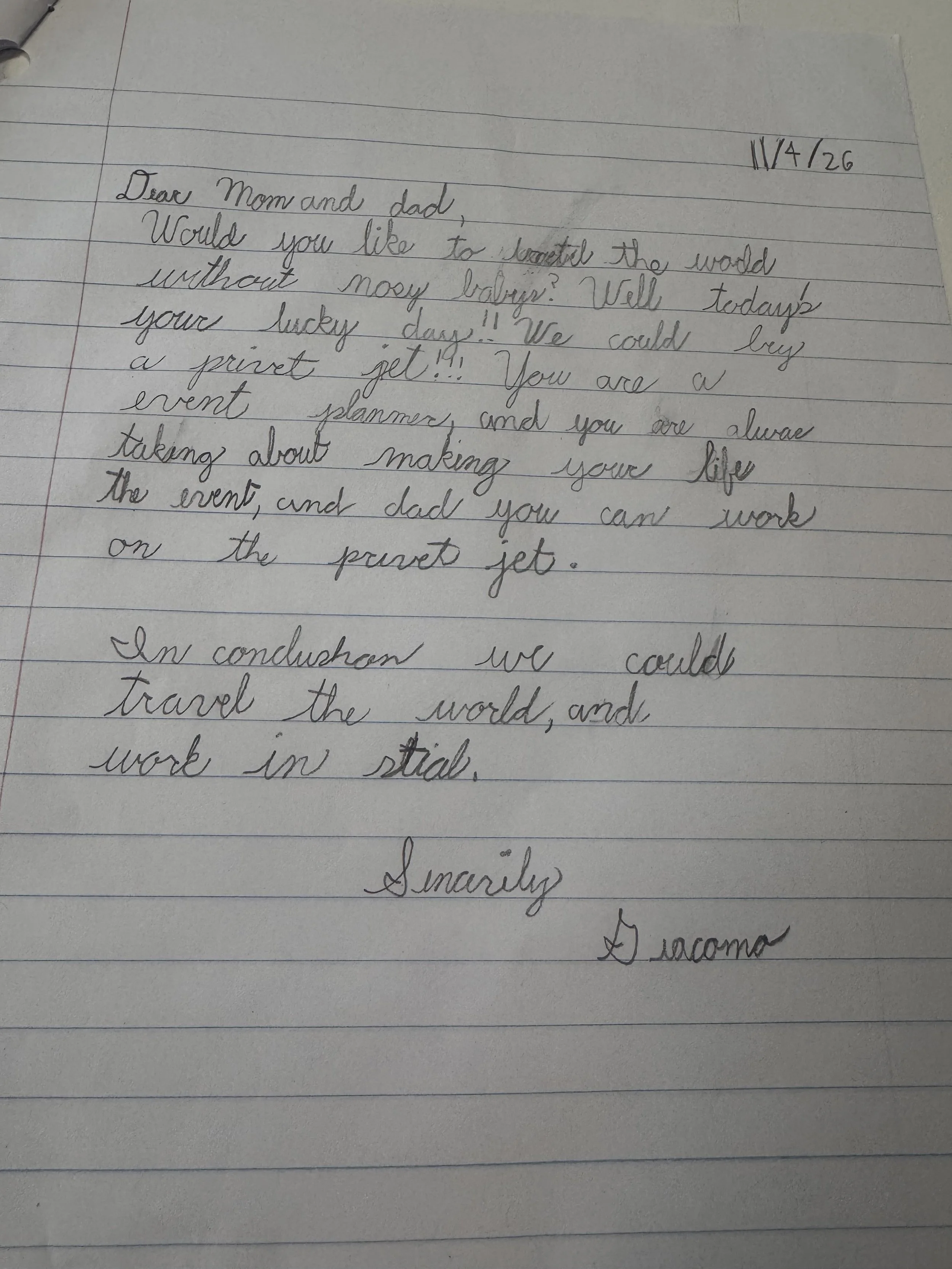
Last week my son Giacomo delighted me with his “persuasive writing assignment”. Handwritten, in his very best cursive, dated and signed, and complete with an "In conclusion."
The pitch? "Would you like to travel the world without noisy babies? Well today's your lucky day!! We could buy a privet jet!!!"
He went on to remind me that I'm an event planner who is always talking about “making your life The Event” (the title of my TED Talk), and he helpfully pointed out that Dad could also run his AI company from anywhere and work on the jet. His closing argument: we could travel the world and work in style.
I laughed, then I framed it in my mind as a perfect Gianna's Gem, because my nine-year-old just walked through the first step of my design process without knowing it. He found the pain point (screaming babies at 30,000 feet), and instead of just putting up with it, he redesigned the whole experience around making it better. He even personalized it for each of his "clients" aka my husband and me! (We are not buying a jet. But I gave him full marks for strategy.)
That's pain point elimination. And it's the single most underrated tool I know for creating moments people remember, at events and in everyday life.
Why the magic is in the gap
Gianna’s Gem: Here's the secret: satisfaction isn't just about how good something is. It's about how good it is compared to what you expected.
The gap between what we expect an experience to be and what it actually turns out to be shapes how satisfied we feel, and how memorable it becomes. Researchers have studied this for decades (it's called expectancy disconfirmation), and every great host has felt it intuitively.
Think about it:
When you expect something to be lovely, and it's lovely, that's nice. Small gap.
When you expect something to be painful or boring, and it turns out to be delightful? That gap is huge.
And that's exactly when your brain hits record. As I share in my TED talk, when something surprises or delights us, the brain sends a hit of dopamine to the hippocampus, our memory center, as if to say: "Save this one. You're going to want to replay it."
So a converted pain point isn't just a problem solved. It's often more enjoyable than an ordinary enjoyable moment, because the expectation was so low. You get relief and delight in the same breath.
Why it's step one in my attendee journey
When I'm looking for ways to add delight to an event, I don't start with the fun stuff. I start with the moments most likely to disappoint.
Take the registration line at a massive conference. "I loooove waiting in a long line in the freezing cold before I've had my coffee," said no one. Ever.
When I was Executive Producer of Google Cloud Next in San Francisco, we had 30,000 people coming through the doors of Moscone Convention Center to view the keynote. No matter how many event ninja tactics we deployed, there was going to be a very, verrrry long line at 6am.
So instead of just managing the pain, we converted it:
Freshly baked donuts from local bakeries
Espresso carts pouring San Francisco's cult coffees, steaming hot
Cups printed with conversation questions so strangers in line actually connected
Local musicians who became a drumline, ushering everyone into the venue
Attendees walked in happier, more relaxed, and more than willing to follow directions, and the part everyone usually complains about became the part they posted about. Delight isn't a nice-to-have. It's a strategy that works.
How to eliminate (or convert) a pain point
Here's the exercise I run with my team and clients:
Walk the journey like a guest. Map every moment from the first invitation to the last goodbye: arrival, parking, check-in, waiting, transitions, meals, bathroom lines, the drive home.
Circle the dread. Where will people be cold, hungry, bored, confused, awkward, or stuck? Be brutally honest. (Dinner party seating roulette counts!)
Ask the flip question. "What would make this the best part?" If you can eliminate the pain entirely, wonderful. If you can't, convert it into something better, enjoyable, or worth laughing about.
Personalize the fix. The best conversions are designed around what these people want most in that moment, like caffeine at 6am.
Watch for the stories. You'll know it worked when the dreaded moment shows up in the post-event chatter.
Take it Home.
This works just as beautifully off the clock. Our family made a (questionable!) commitment never to hand our son a device at restaurants, (which can turn dinners out into a 45-minute hostage negotiation). So I keep a deck of conversation cards in my purse. Always. The long wait for food became the part of the meal where we laugh the most, learn new things about each other, and sometimes even recruit our server. Crisis averted, memories made.
So ask yourself: what's the "registration line" in your day? The commute, the school pickup, the laundry, the weekly status meeting, the long flight (with or without noisy babies)? How could you flip it from dread to delight, or at least into a good story you'll laugh about later?
When you start converting the hard parts, you don't just get through your days. You remember them. And your memory is the only version of your life you get to keep.
Let's flip your pain points together
I genuinely love this exercise. Whether it's your company's next conference, a customer event, an executive offsite, or a personal celebration, I'd love to help you find the moments your guests are quietly dreading and turn them into the ones they can't stop talking about. Reach out and let's get started.
Your life IS the event. Make it worth attending.
xx, Gianna
p.s. What I’m loving: Monet.io’s Booth mapping analysis
Check out this awesome use of AI for 10Xing the value of your tradeshow booth and making sure your booth selection is bulletproof: Monet.io, an ai-native startup I advise builds software that lays out show floors inside the real venue, to scale, and they used their crowd simulation on the show floor to evaluate how very small details in booth strategy and mapping can cost you massive budget.
They recently took two 10 × 10 ft booths at IMEX America 2026. One had 1,100 people an hour. The other, 360. Same size booth. Same show. 3x difference in results. Where your booth sits MAY just matter more than how it looks, and you could save a substantial budget with this kind of intel.
Here’s the full report: https://www.monet.io/reports/imex-america-2026?utm_source=advisor_linkedin&utm_medium=social&utm_campaign=imex_report
AND… The @Monet.io team is offering a report for your own booth: send your booth design and the show's floor plan to info@monet.io, or I'm happy to connect you with Juliano Wahab directly if you email me a request and context.
Want to live with more intention, personalisation and delight?
Book a 15 - 60 minute consulting call here on INTRO: intro.co/GiannaGaudini